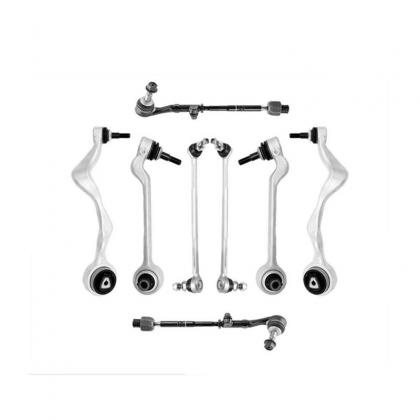
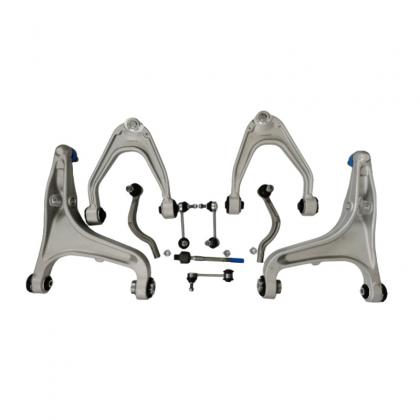
OEM Code 31126769797, 31124036269, 31122409599, 31122405861, 31126769798, 31126769802, 31124036270, 31126770849, 31122405859, 31126763699, 31126770850, 31126763700 MOQ 1 set Payment Term 30% TT Pay in Advance, Balance Pay Against B/L Copy, L/C Trading Term FOB, CIF, CFR, EXW Package Neutral Package or with Your Logo Package Service OEM & ODM
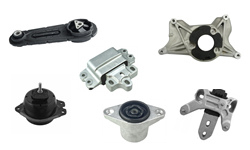
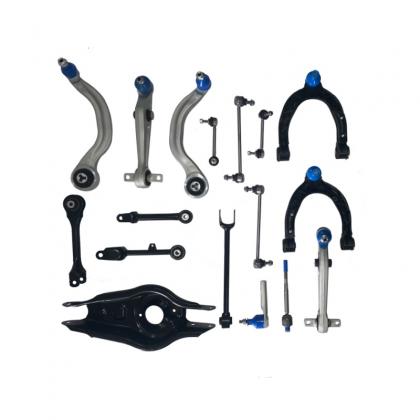
Read MoreOEM Code 2123301911 / A2123301911, 2123303111 / A2123303111, 2123303211 / A2123303211, 2123202589 / A2123202589, 2123202689 / A2123202689, 2123302403 / A2123302403 / 2124600105 / A2124600105, 2123302703 / A2123302703 / 2124600205 / A2124600205, 2123302803 / 2223309502 / A2123302803 / A2223309502 MOQ 1 set Payment Term 30% TT Pay in Advance, Balance Pay Against B/L Copy, L/C Trading Term FOB, CIF, CFR, EXW Package Neutral Package or with Your Logo Package Service OEM & ODM
Read MoreOEM Code 670107802, 670107803 MOQ 1set Payment Term 30% TT Pay in Advance, Balance Pay Against B/L Copy, L/C Trading Term FOB, CIF, CFR, EXW Package Neutral Package or with Your Logo Package Service OEM & ODM
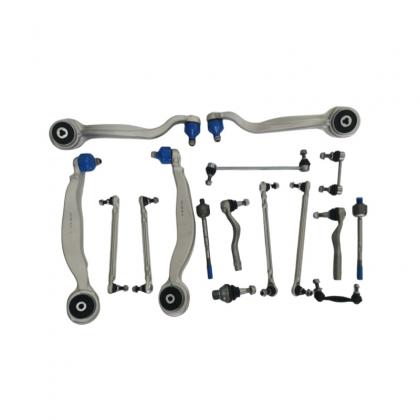
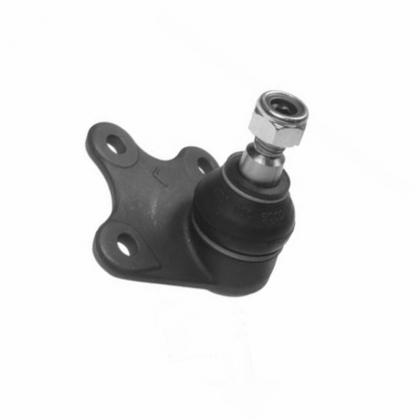
Read MoreOEM Code 6Q0407365A, 6Q0407365B, 6Q0407365M, 8Z0407365A MOQ 1pcs Payment Term 30% TT Pay in Advance, Balance Pay Against B/L Copy, L/C Trading Term FOB, CIF, CFR, EXW Package Neutral Package or with Your Logo Package Service OEM & ODM
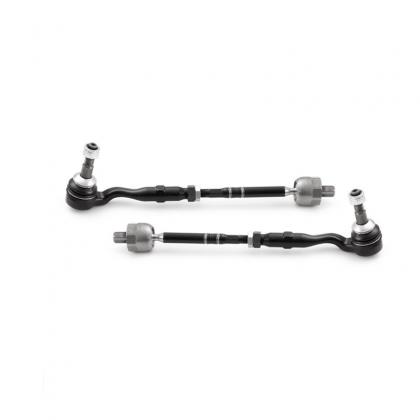
Read MoreOEM Code 32106784716 MOQ 1pcs Payment Term 30% TT Pay in Advance, Balance Pay Against B/L Copy, L/C Trading Term FOB, CIF, CFR, EXW Package Neutral Package or with Your Logo Package Service OEM & ODM
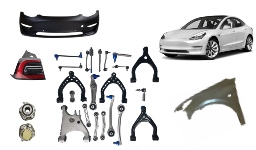
Read MoreOEM Code 1044321-00-J, 1044321-00-H, 1044326-00-J, 1044326-00-H, 1044351-00-C, 1044356-00-C, 1188391-00-B, 1188396-00-B, 104483100F-N, 104483100F-W MOQ 1set Payment Term 30% TT Pay in Advance, Balance Pay Against B/L Copy, L/C Trading Term FOB, CIF, CFR, EXW Package Neutral Package or with Your Logo Package Service OEM & ODM
Read More
Worldwide Customers with High Quality

Years Experience
December
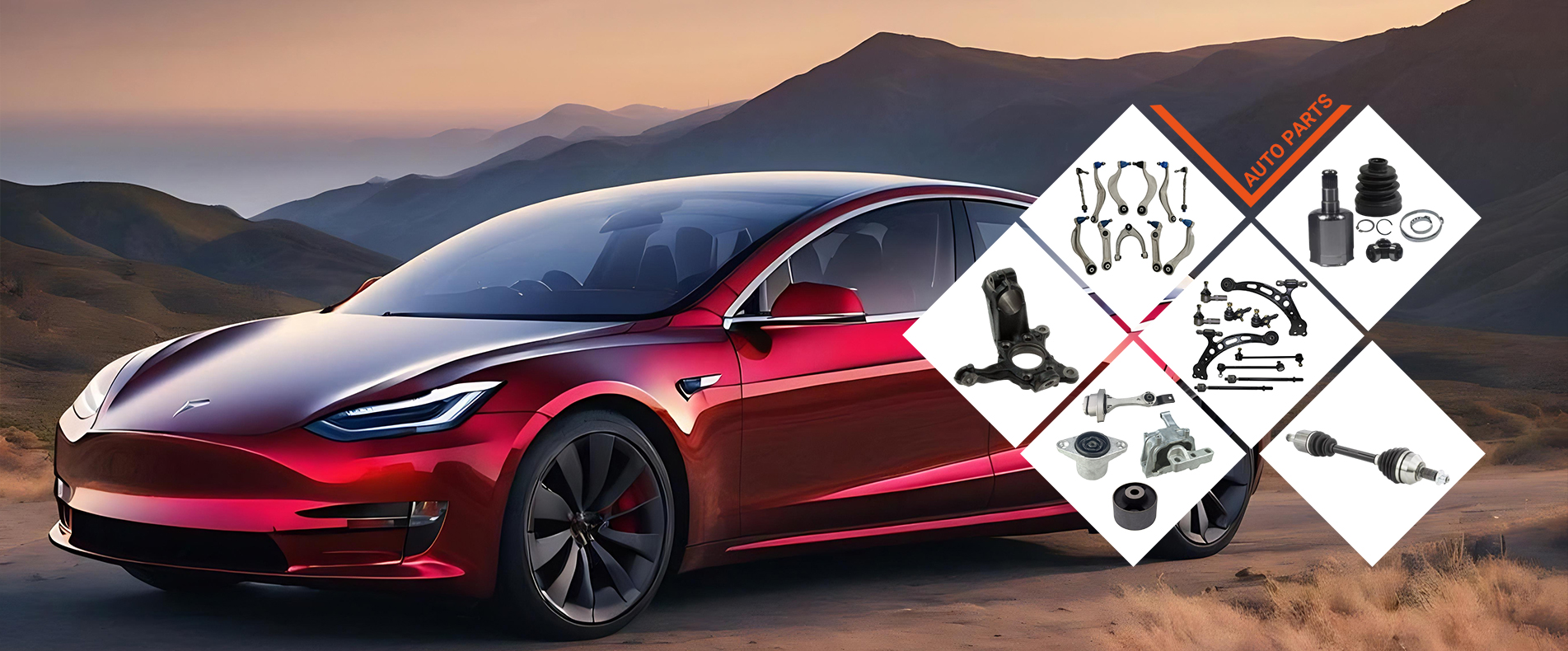
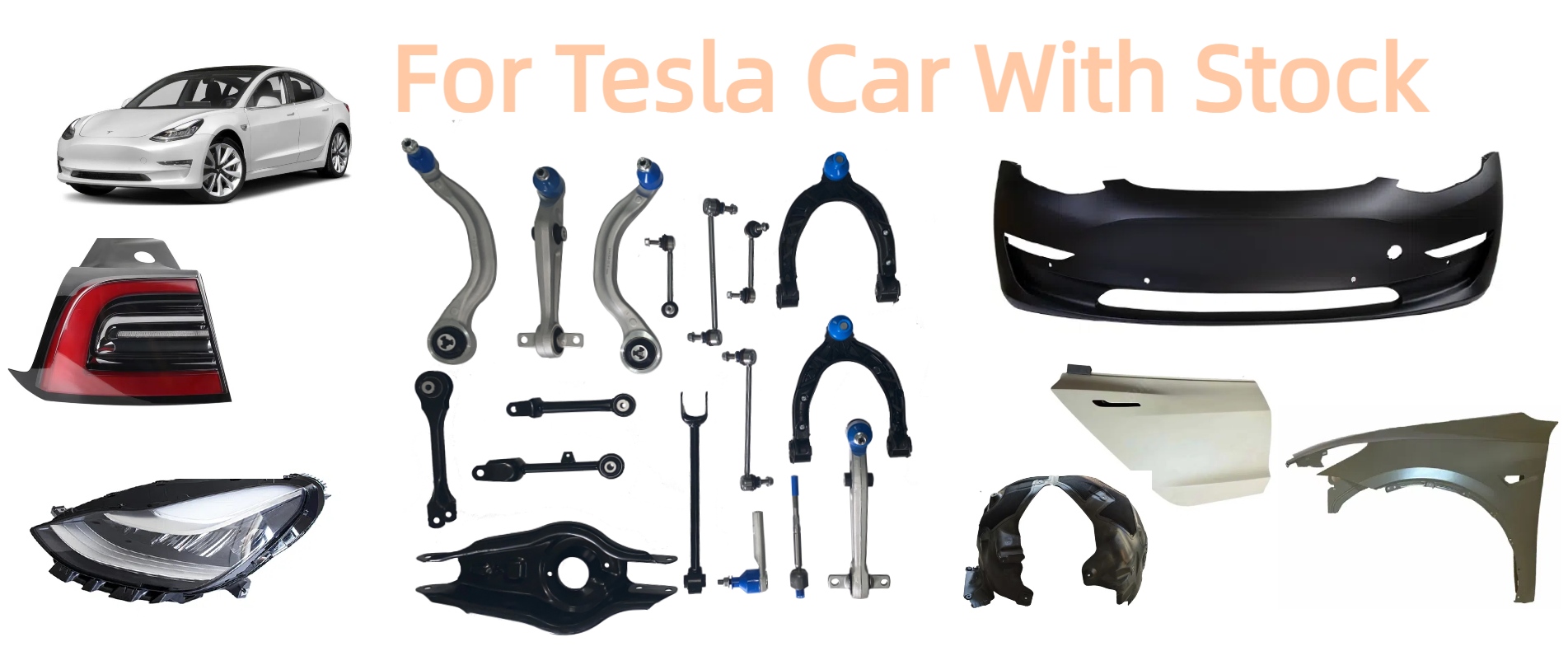
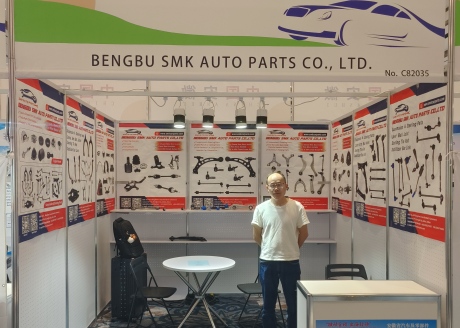
Bengbu SMK Auto Parts Co.,Ltd attend the Automotive Aftermarket Products Expo AAPEX 2024 in Las Vegas, USA. We Produce Suspension & Steering Parts Fits for VAG VW Skoda Seat Audi BMW Mini Mercedes Benz Smart Porsche Tesla Land Rover Jaguar Ford Fiat Opel Vauxhall Chevrolet Nissan Renault Toyota Mitsubishi Suzuki Peugeot Citroen Hyundai Kia Daewoo Lexus Acura Infiniti Sabaru Volvo Saab Jeep Chrysler Dodge Mercury GMC Lincoln Cadillac... Besides, We supply aftermarket parts for Tesla Model 3 Y S X Car, and stock available.
Read More
December
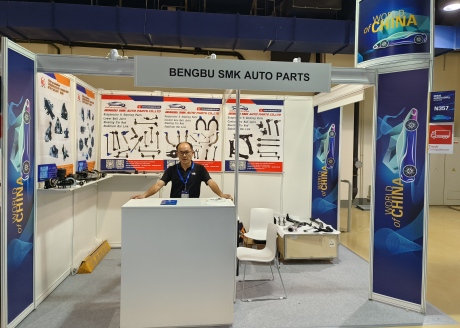
Bengbu SMK Auto Parts Co.,Ltd Attend the auto parts show of MIMS Automobility Moscow 2024 where we meet the customers from Russia there. We produce and supply suspension and steering parts such as control arm ball joint steering knucle shock absorber engine mounting to Russia market for Japanese car, Europe Car, Chinese car...
Read More
December
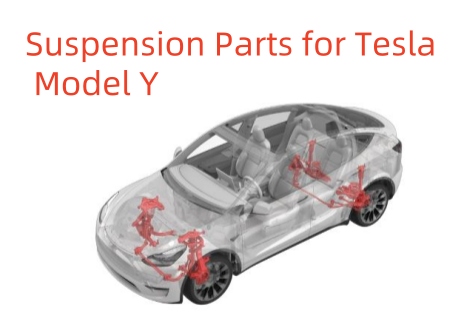
The Suspension Parts List and Catalogue for Tesla Model Y diagram online, contact for pdf files Model Y Collision Repair Procedures Manual aftermarket replace parts only 31 - Suspension Front and Rear Knuckle - Hub and Bearing Front and Rear Stabilizer Bar and Links Front and Rear Suspension Arms Front Coil Spring and Damper Rear Coil Spring and Damper 30 - Chassis 3001 - Chassis and Subframes FRONT SUBFRAME ASSEMBLY 1044531-01-B REAR SUBFRAME ASSEMBLY 1044580-01-D REAR SUBFRAME SHEAR PLATE- FRONT - RIGHT HAND 1044576-00-D REAR SUBFRAME SHEAR PLATE- FRONT - LEFT HAND 1044573-00-D 3101 - Front Suspension (including Hubs) FRONT KNUCKLE - LEFT HAND 1188311-00-F FRONT KNUCKLE - RIGHT HAND 1188316-00-F DRIVEN HUB 150MM FLANGE 1044121-00-E NON DRIVEN HUB 150MM FLANGE 1044122-00-E DRIVEN HUB 142MM FLANGE 1044123-00-B FR LWR COMP LINK ASSY CN, ZF LH 2188354-10-B FR LWR COMP LINK ASSY, CN, RH 2188359-10-B FRONT LOWER LATERAL LINK ASSEMBLY 1188341-00-C FRONT UPPER CONTROL ARM ASSEMBLY - LEFT HAND 1044321-00-J FRONT UPPER CONTROL ARM ASSEMBLY - RIGHT HAND 1044326-00-J FRONT UPPER CONTROL ARM ASSEMBLY - LEFT HAND 1188321-00-A FRONT UPPER CONTROL ARM ASSEMBLY - RIGHT HAND 1188326-00-A FRONT HEIGHT SENSOR ASSEMBLY - LEFT HAND 1044941-00-B FRONT STABILIZER BAR ASSEMBLY 28 MM X 5.0 MM 1144387-00-B FRONT STABILIZER BAR ASSEMBLY - 31MM X 4.7 MM 1188386-00-A FRONT STABILIZER LINK ASSEMBLY- LEFT HAND 1188391-00-B FRONT STABILIZER LINK ASSEMBLY- RIGHT HAND 1188396-00-B FRONT BRACKET- STABILIZER BAR BUSHING 1188383-00-A 3103 - Rear Suspension (including Hubs) REAR KNUCKLE ASSEMBLY - LEFT HAND 1188411-00-G REAR KNUCKLE ASSEMBLY - RIGHT HAND 1188416-00-G DRIVEN HUB 142MM FLANGE 1044123-00-B REAR LOWER AFT LINK ASSEMBLY 1044451-00-F REAR UPPER AFT LINK ASSEMBLY - 25X19 1188423-00-A REAR UPPER AFT LINK ASSEMBLY - 25X19 1188423-00-B REAR UPPER FORE LINK 1188421-00-B REAR LOWER FORE LINK ASSEMBLY 1044441-00-F REAR TOE LINK ASSEMBLY 1188431-00-A REAR HEIGHT SENSOR ASSEMBLY - LEFT HAND 1044971-00-C REAR STABILIZER BAR ASSEMBLY - 23.6MM X 3.5MM 1044481-00-E REAR STABILIZER BAR ASSEMBLY - 25.2X4.4MM 1188485-00-A REAR STABILIZER BAR LINK - LEFT HAND 1044491-00-F REAR STABILIZER BAR LINK - RIGHT HAND 1044496-00-F 3115 - Coil Spring Suspension System DAMPER ASSEMBLY COIL E3 - DUAL MOTOR - FRONT LEFT HAND 1188363-00-E DAMPER ASSEMBLY COIL E3 - FRONT LEFT HAND 1188363-00-H DAMPER ASSEMBLY COIL E1 - REAR WHEEL DRIVE - FRONT LEFT HAND 1188364-00-C DAMPER ASSEMBLY COIL E1 - REAR WHEEL DRIVE - FRONT LEFT HAND 1188365-00-B DAMPER ASSEMBLY COIL E3 - DUAL MOTOR - FRONT RIGHT HAND 1188368-00-E DAMPER ASSEMBLY COIL E3 - DUAL MOTOR - FRONT RIGHT HAND 1188368-00-H DAMPER ASSEMBLY COIL E1 - REAR WHEEL DRIVE - FRONT RIGHT HAND 1188369-00-C FRONT DAMPER ASSEMBLY - PERFORMANCE COIL - FRONT - DUAL MOTOR PERFORMANCE 1188371-00-E DAMPER ASSEMBLY COIL E3 - DUAL MOTOR PERFORMANCE - FRONT LEFT HAND 1188371-00-F FRONT DAMPER ASSEMBLY - RIGHT HAND - PERFORMANCE 1188376-00-E DAMPER ASSEMBLY COIL E3 - DUAL MOTOR PERFORMANCE - FRONT RIGHT HAND 1188376-00-F DAMPER ASSEMBLY COIL E1 - REAR WHEEL DRIVE - FRONT RIGHT HAND 1188379-00-B DAMPER ASSEMBLY COIL E1 - REAR WHEEL DRIVE - FRONT LEFT HAND 1288365-00-B DAMPER ASSEMBLY COIL E1 - REAR WHEEL DRIVE - FRONT RIGHT HAND 1288379-00-B MOUNT- FRONT UPPER CONTROL ARM - LEFT HAND 1044371-00-D MOUNT- FRONT UPPER CONTROL ARM - RIGHT HAND 1044376-00-D MOUNT ISOLATOR- FRONT UPPER CONTROL ARM - LEFT HAND 1044031-00-B MOUNT ISOLATOR- FRONT UPPER CONTROL ARM - RIGHT HAND 1044036-00-B DAMPER ASSEMBLY COIL - DUAL MOTOR - REAR 1188463-00-C DAMPER ASSEMBLY COIL - REAR WHEEL DRIVE - REAR 1188463-00-E DAMPER ASSEMBLY COIL - REAR WHEEL DRIVE - REAR 1188463-50-E DAMPER ASSEMBLY COIL - REAR WHEEL DRIVE - REAR 1188464-00-B REAR DAMPER ASSEMBLY - DUAL MOTOR PERFORMANCE 1188465-00-E DAMPER ASSEMBLY COIL - DUAL MOTOR PERFORMANCE - REAR 1188465-00-F REAR SPRING UPPER ISOLATOR 1188471-00-C SPRING, REAR, COIL 88.0-6750. 1188472-00-B SPRING - REAR - COIL 90.0-7200 1188474-00-B SPRING - REAR - COIL 90.0-7200 LOW 1188475-00-D SPRING - REAR - COIL 81-6850 1188476-00-B REAR SPRING ASSEMBLY - COIL 88-6850 1188479-00-A REAR SPRING ASSEMBLY COIL 81-7300 2288474-00-A REAR SPRING LOWER ISOLATOR 1044479-00-E RETENTION WASHER - M10. 1044407-00-A REAR JOUNCE BUMPER 1044464-00-C
Read More
June
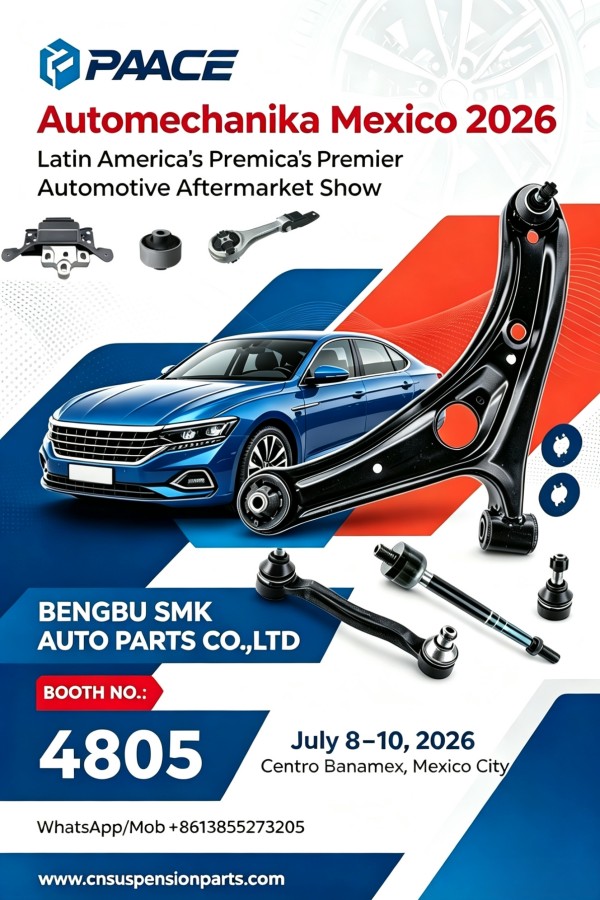
We will attend the INA PAACE Automechanika Mexico Fair 2026 with Suspension & Steering Parts and Engine Mounting, looking forward to see you at Mexico City. Aftermarket Tesla Replace Parts Stock Available. Welcome to the largest event for the Automotive Aftermarket Industry in Latin America. from July 8th to 10th, 2026 at Centro Banamex, Mexico City. Booth No.:4803 BENGBU SMK AUTO PARTS CO.,LTD Contact by WhatsApp:+8613855273205
Read More
December
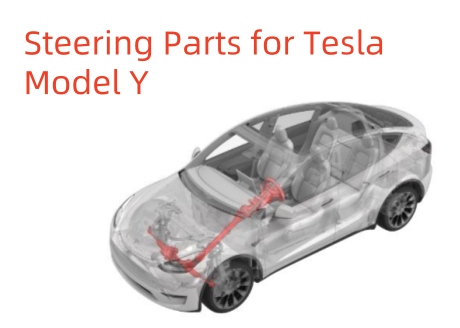
Steering Parts online Catalogue Diagram List for Tesla Model Y, for pdf files contact us. Model Y Collision Repair Procedures Manual or Aftermarket Replace use 32 - Steering 3201 - Steering Rack and Lower Column STEERING GEAR ASSEMBLY - LEFT HAND DRIVE 1044832-00-B STEERING GEAR ASSY, LEFT HAND DRIVE 1188833-00-A 3205 - Upper Column and Steering Wheel STEERING WHEEL - PUR LEATHER 1490214-CN-D STEERING WEEL ASSEMBLY - PUR HEATED 1626599-00-D Steering Rim Assembly 2092566-00-A ELECTRIC STEERING COLUMN - LEFT HAND DRIVE 1188871-00-A STEERING COLUMN CONTROL MODULE 1097662-00-R INSTRUMENT PANEL STEERING COLUMN SHROUD UPPER ASSEMBLY 1683771-00-A STEERING WHEEL SWITCH - LEFT HAND - MATTE ALUMINUM 1094966-02-G STEERING WHEEL SWITCH - RIGHT HAND - MATTE ALUMINUM 1094965-02-G STEERING WHEEL ELECTRONIC CONTROL UNIT ASSEMBLY 1101556-03-C STEERING WHEEL - LOWER SPOKE COVER 1096972-00-D STEERING WHEEL - LOWER SPOKE COVER 1626612-00-A INSTRUMENT PANEL - STEERING COLUMN - SHROUD LOWER SUB 1099284-80-E INSTRUMENT PANEL - STEERING COLUMN - SHROUD LOWER SUB 1683775-00-A HEATED SWITCH SPOKE BRIGHT SURROUND 1508162-00-B STEERING WHEEL BRIGHT SURROUND 1626613-00-B SWITCH HARNESS 1508163-00-B SWITCH HARNESS 1626615-00-A STEERING WHEEL - HORN ASSEMBLY 1119156-00-D INSTRUMENT PANEL STEERING COLUMN UPPER GAP HIDER ASSEMBLY 1683951-00-A
Read More
June
Correction of Misconceptions: After-sales parts are not necessarily better when heavier! Exploring the relationship between part weight and performance A widespread misconception has long prevailed in the automotive aftermarket: the heavier an auto part is, the better its quality and durability. Many repair shop purchasers and vehicle owners tend to judge parts simply by their weight. They believe a solid, heavy component means sufficient raw materials and reliable quality, while a lighter one is labeled as shoddy work with cut corners. As a manufacturer specializing in automotive spare parts, we produce a full range of chassis parts, rubber components, metal structural parts and more. Drawing on our decades of experience in production processes, material selection, structural design and real-vehicle testing, we’re here to clarify this misunderstanding and elaborate on the actual links between part weight, material, structure and overall performance. 1. Where does the "heavier equals better" mindset come from? This biased judgment did not emerge out of nowhere. In the early days, low-grade aftermarket products commonly suffered from insufficient material usage. For instance, control arms made of thin stamped steel, brake discs cast with substandard iron materials, and rubber parts mixed with inferior fillers were noticeably light in weight. Once installed on vehicles, such parts were prone to deformation, fracture and rapid wear. Gradually, the market formed a simplistic rule of thumb: heavier parts = solid materials = dependable quality. However, this standard only applied to outdated products with primitive craftsmanship and rough designs. It is completely incompatible with modern manufacturing technologies, advanced materials and professional industrial design concepts today. 2. The core truth: Weight is determined by design and materials, not a direct indicator of performance The weight of an auto part is never a single measure of its quality. It is comprehensively defined by three key factors: original factory design standards, applied materials and internal structural optimization. More weight does not equate to higher performance or longer service life. 2.1 Advanced lightweight materials reduce weight while boosting performance Modern automotive manufacturing widely adopts high-strength alloys, reinforced composite materials and modified engineering plastics. These materials feature higher strength, better toughness and stronger corrosion resistance than traditional ordinary iron and steel, yet they weigh far less. Take chassis components as an example: A high-strength aluminum alloy control arm is much lighter than a traditional cast iron counterpart, but it delivers equal or even better load-bearing capacity and shock resistance. Excessive weight on unsprung mass will increase tire wear, affect steering flexibility and driving comfort. In this case, reasonable weight reduction is a design advantage, not a sign of poor quality. 2.2 Optimized structural design cuts redundant weight without compromising durability Professional R&D and production teams will conduct finite element analysis to remove redundant material while reinforcing stress-bearing key areas. This structural optimization ensures the part meets all mechanical performance requirements, and effectively avoids extra weight. By contrast, some low-end manufacturers simply thicken the overall wall thickness and pile up raw materials to increase weight, without optimizing the stress structure. Such parts are heavy indeed, yet they still fail easily at key stress points. The extra weight only adds burden to the vehicle, instead of improving durability. 2.3 Different functional parts have distinct weight design logic Brake parts: A moderately weighted brake disc with reasonable heat dissipation structure and qualified metallographic treatment works far better than an overweight disc made of impure cast iron. Excess weight will lead to poor heat dissipation and increased brake fade. Rubber & suspension parts: Qualified rubber bushings and shock absorbers rely on precise rubber formulas and internal damping structures for performance. Adding filler to increase weight will only harden the rubber, cause abnormal noises and weaken shock absorption. 3. How to correctly judge the quality of aftermarket parts? Abandon the simplistic "weight test". Focus on these practical points when selecting parts: Appearance & workmanship: Check surface finish, machining precision, uniform paint/coating and seamless assembly. Rough burrs, uneven paint and loose assembly are typical signs of inferior products. Material texture: Identify the type of raw materials. High-strength materials feel compact and uniform, while low-grade materials often look loose and shoddy. Structural rationality: Observe whether key stress positions are reasonably reinforced, and whether the overall structure conforms to the original design standards. Parameter matching: Verify ...
Read More
June
Why Tesla Aftermarket Body Parts Prefer Full Container (FCL) Shipping 1. Cut unit logistics cost drastically (Core driver) FCL collects fixed ocean freight for one full container regardless of loading volume, spreading total shipping expense across hundreds of bumpers, hoods, fenders and door panels to slash single-piece freight cost sharply vs LCL consolidation. LCL adds extra CFS warehouse, sorting and split-delivery surcharges; bulk full-container shipment eliminates these miscellaneous fees and matches large monthly restocking demand of global Tesla repair distributors and collision shops. 2. Avoid dent/deformation for fragile aluminum body panels Most Tesla aftermarket body components are thin aluminum alloy, easily scratched or dented by mixed heavy cargo from other shippers inside shared LCL containers. Exclusive full-container space allows customized internal bracing, classified nested packaging and fixed pallet layout without extruding collision during transit and port loading/unloading, greatly lowering high claim losses on pricey EV body spare parts. 3. Predictable transit lead time & faster customs clearance All cargo under one consignee with unified customs documents, skipping multi-supplier cargo collection and destination deconsolidation required for LCL. No shipment delay triggered by customs detention of unrelated third-party goods, supporting regional aftermarket warehouses’ planned inventory replenishment and shortening vehicle downtime for collision repair. 4. Secure high-value body spare parts against theft Tesla aftermarket body assemblies carry high individual value; sealed full containers are locked at origin factory and only opened at target depot, cutting pilferage risks during intermediate port storage and transshipment compared with unpacked LCL goods stored in shared consolidation warehouses. 5. Optimize loading rate for irregular oversized body parts Bumpers, hood shells and complete door assemblies feature irregular bulky outlines hard to utilize scattered LCL pallet space. 40HQ full containers adopt targeted nested packing design to maximize cubic usage for odd-shaped body panels and improve overall container loading efficiency. 6. Fit Tesla global centralized aftermarket inventory layout Tesla’s worldwide authorized service network adopts big-data demand forecasting for regular bulk restocking of fast-moving collision body parts; scheduled FCL fixed-vessel shipments enable stable inbound arrival dates to execute JIT inventory management and prevent frequent out-of-stock of core replacement body parts across regions.
Read More
May
Hydraulic vs. Air Suspension: Which One Offers a Smoother Ride? Quick conclusion: For overall comfort and a plush, smooth daily ride, air suspension is superior. Hydraulic suspension delivers firmer damping, better load handling and performance, but a less compliant ride over regular road imperfections. 1. Core Working Principles Hydraulic Suspension Uses hydraulic fluid + pistons/valves to control damping and support vehicle weight. Most common in standard factory setups, heavy-duty vehicles and performance hydraulic systems. Relies on fixed or semi-adjustable valve settings to absorb vibration. Spring load is constant; ride height stays fixed in basic versions. Air Suspension Replaces traditional steel springs with rubber air bags (air springs) paired with an air compressor and control valves. Adjust air pressure to alter spring stiffness and ride height in real time. Air cushions absorb small bumps far more gently than metal springs/hydraulic pistons. 2. Ride Comfort & Smoothness Comparison Air Suspension (Smoother Ride Winner) Advantages for comfort 1. Excellent small-bump isolation Air bags flex softly over potholes, cracked roads and rough pavement. Road noise and minor vibration are heavily filtered out, creating a floaty, plush ride ideal for luxury cars, MPVs and long-distance driving. 2. Adaptive tuning Modern systems adjust air pressure automatically: softer for cruising, slightly firmer at high speed to reduce body roll. 3. Load adaptability Ride quality stays consistent whether the car is empty or fully loaded; no sagging or stiffening under weight. Drawbacks Feels softer and less sporty during sharp cornering or hard braking. More complex components (compressor, lines, bags) mean higher maintenance costs long-term. Hydraulic Suspension Ride characteristics Firmer, more connected road feel. It handles mid-to-large impacts well but transmits more minor road harshness into the cabin. Standard hydraulic setups have fixed stiffness: smooth on perfectly paved roads, bumpy on uneven surfaces. Performance hydraulic systems (e.g., race/street hydraulics) are even stiffer, prioritizing handling over comfort. Advantages Robust structure, strong load-bearing capacity (widely used for trucks, vans and commercial vehicles). Simple structure, lower failure risk and cheaper routine maintenance. 3. Scenario-Based Selection Guide Choose Air Suspension if you prioritize a smoother ride: Luxury passenger cars, family vehicles, long highway commutes Frequently drive on uneven urban roads or rough country roads Want adjustable ride height + variable comfort modes Passenger comfort is your top priority Choose Hydraulic Suspension if: You own a commercial vehicle, pickup truck or heavy-load carrier You prefer a sporty, firm handling feel over maximum softness You want low maintenance, high durability and a budget-friendly setup Mainly drive on well-maintained highways 4. Extra Notes on Modern Upgrades Adaptive hydraulic dampers: Can slightly improve comfort, but still cannot match the plushness of air suspension. Air suspension limitations: Air bags degrade over time; leaks and compressor failure are common issues after years of use. Extreme off-roading: Heavy-duty hydraulic setups are more reliable than basic air suspension. Final Verdict Smoother, plusher daily ride → Air Suspension Firm control, heavy loads, low maintenance → Hydraulic Suspension
Read More
May
With the rapid expansion of the global automotive aftermarket, China auto parts have become an indispensable part of the international supply chain, featuring high cost performance, perfect compatibility and continuous technological upgrading. We break traditional market prejudices against Chinese automotive components and build solid overseas reputation throughreliable quality and professional after sales service. Adhering to strict quality control, long-term warranty policies and full compliance with European and American vehicle standards, we have earned consistent recognition from global distributors, repair shops and end vehicle owners. 1. Strict Quality Control System for Trustworthy Export Quality Quality is the core competitiveness and fundamental foundation for Chinese auto parts to explore global markets. To meet the stringent requirements of international trade and overseas vehicle operation environments, we have established a standardized full-process quality control system. Closed-loop quality management covers raw material selection, production processing, precision manufacturing and finished product testing, ensuring stable and consistent performance of every exported auto part. We select high-quality raw material suppliers with higher admission standards than industrial norms, effectively avoiding material defects and performance instability. Automated production equipment and refined manufacturing procedures are adopted to unify production standards and strictly control dimensional accuracy, structural stability and driving safety. Before delivery, all products undergo rigorous tests including wear resistance, high temperature resistance, pressure resistance and adaptive compatibility inspection. Every qualified product delivered overseas fully proves our reliable quality. All our auto parts are fully calibrated to European and American market standards, perfectly matching the specifications, operating conditions and usage habits of mainstream European and American vehicle models. Optimized formulas and manufacturing processes are applied to adapt to complex local road conditions, variable climates and strict overseas automotive access regulations. With superior compatibility, durability and safety, our products effectively solve overseas adaptation pain points and steadily build up global quality credibility. 2. Long-Term Warranty to Enhance Global Customer Trust Different from ordinary exported auto parts with short warranty periods and insufficient after-sales support, our products are equipped with reliable long-term warranty services. This policy eliminates the stereotype of unstable quality and insecure after-sales service for Chinese auto parts, greatly improving market competitiveness and customer trust. We tailor diversified warranty solutions for different product categories and usage scenarios, with warranty cycles fully aligned with European and American consumption standards and far exceeding ordinary industrial warranty terms. Complete and transparent warranty commitments cover engine parts, chassis parts, electrical components and body wearing parts without ambiguous or restrictive clauses. Within the warranty period, free replacement, professional maintenance and technical support are provided for all non-human-induced quality failures. Our long-term warranty service demonstrates full confidence in product quality, fully protects the rights and interests of global buyers, reduces procurement and usage risks, and continuously accumulates high-quality market reputation. 3. Comprehensive After-Sales Service for Long-Term Global Cooperation Professional after sales service is the key support for our long-term global market layout and stable cooperative relationships. To solve overseas operational difficulties including long-distance communication, time zone differences and diverse maintenance demands, we have built a global and three-dimensional after-sales system, providing efficient, convenient and professional full-cycle services for international distributors and terminal users. In the pre-sales stage, our multilingual professional team provides accurate model matching, parameter verification, product adaptation consultation and customized procurement solutions, helping customers select suitable products and avoid procurement errors. During order execution, we track production, quality inspection and logistics progress in real time, synchronize order updates timely, and provide exclusive docking services for bulk orders to ensure safe and on-time delivery. In the after-sales stage, we maintain a rapid response mechanism to answer technical inquiries and handle after-sales requests efficiently regardless of time zones and regions. We provide systematic technical training, installation guidance and fault diagnosis support for cooperative distributors to improve local terminal service capabilities. Overseas warehouses and service outlets in key regions enable fast parts repleni...
Read More
May
Advantages of Mazda Cars 1. Outstanding Driving Dynamics (Jinba Ittai) Precise steering & sharp handling: Tight turn-in, minimal body roll, and well-tuned suspension (GVC Plus) deliver “horse-and-rider” connection. Skyactiv powertrains: High-compression (13:1) naturally aspirated engines + smooth 6AT/6MT balance responsive power and real-world fuel economy. Lightweight chassis: Rigid, light platforms enhance agility and efficiency. 2. Striking, Timeless Design Kodo Design: Flowing lines, signature grille, and premium proportions stand out without aging quickly. Upscale interiors: Soft-touch materials, minimalist layouts, and consistent build quality near luxury brands. 3. Strong Reliability & Safety Top-tier dependability: Consistently ranks top 3 in Consumer Reports/J.D. Power; low long-term repair costs. High-strength construction: Extensive use of high-tensile steel; standard safety suites (i-Activsense) earn top crash-test ratings. Solid resale value: Models like Mazda3, CX-5, MX-5 hold value well vs. mainstream rivals. 4. Fuel Efficiency & Low Emissions Skyactiv-G engines: Efficient combustion; many models avoid gasoline particulate filters. MX-5 Miata: Lightweight design delivers over 40 MPG (real-world). Disadvantages of Mazda Cars 1. Tight Interior & Cargo Space Rear seats: Short legroom and sloped rooflines limit comfort (Mazda3, CX-5). Cargo capacity: Smaller trunks/cargo areas vs. Honda CR-V/Toyota RAV4; less family-friendly. 2. Firm Ride & NVH Compromises Stiff suspension: Sport tuning transmits more road noise and harshness over bumps. Noise intrusion: Noticeable wind/road noise at highway speeds; coarse engine note under hard acceleration. 3. Limited Powertrain & EV Options No mainstream turbos: Most markets rely on 2.0L/2.5L NA engines; less low-end torque than turbo rivals. Slow electrification: Only recent PHEV (CX-90) and upcoming EV; no mass-market hybrid/EV lineup. 4. Outdated Infotainment & Higher Costs Rotary controller: Pre-2020 non-touchscreen systems are less intuitive for touch users. Premium pricing: Higher base prices than Korean/Chinese rivals; shorter maintenance intervals (5,000 km) raise ownership costs. 5. Niche Brand Perception Smaller dealer network: Fewer locations vs. Toyota/Honda; resale lags top Japanese brands. Summary Mazda excels at driver engagement, design, reliability, and efficiency—ideal for enthusiasts and style-focused buyers. Trade-offs are practicality (space), comfort (ride quality), and tech/powertrain variety, making it less ideal for large families or EV-first shoppers. Mazda vs Toyota vs Honda vs Subaru Core Differences (Concise English Version) 1. Driving Performance Mazda: Best handling, sharp steering, firm suspension, driver-oriented feel; natural aspirated engines, smooth power output. Toyota: Soft stable chassis, gentle driving feel, comfortable daily ride; power is calm and sufficient. Honda: Balanced control, quick acceleration, flexible power; sporty sense stronger than Toyota. Subaru: Standard AWD as advantage, excellent snow/off-road stability; solid chassis, heavy driving feel. 2. Space & Practicality Mazda: Interior & trunk space narrowest; rear legroom limited, not friendly for big families. Toyota: Largest practical space, reasonable layout, best for family daily use. Honda: Space utilization rate top-level, magic seat design, flexible storage. Subaru: Middle level; space ordinary, focus on passing ability not cargo capacity. 3. Fuel Economy Toyota: Hybrid version ultra fuel-saving, overall fuel economy leading. Honda: Good gasoline engine economy, hybrid performance steady. Mazda: Skyactiv engine high efficiency, daily fuel consumption low. Subaru: Higher fuel consumption due to AWD & horizontal engine. 4. Reliability & Maintenance Toyota: Top global reliability, lowest failure rate, cheap spare parts. Honda: Stable quality, durable engine, easy maintenance. Mazda: Less faults overall, chassis parts durable; medium maintenance cost. Subaru: Engine & AWD system durable, but maintenance & parts price higher. 5. Exterior & Interior Mazda: Kodo design most stylish, interior texture close to luxury cars. Toyota: Appearance conservative, interior practical, lack of sense of refinement. Honda: Young sporty style, interior simple and functional. Subaru: Rugged outdoor style, interior plain, focus on practicality. 6. Price & Resale Value Resale Value: Toyota > Honda > Mazda > Subaru Original Car Price: Mazda overall higher than same-level Toyota/Honda Cost Performance: Honda & Toyota better for family use 7. Suitable Crowd Choose Mazda: Love driving fun, pursue appearance and texture, single / small family. Choose Toyota: Pursue durability, fuel saving, large family, long-term car use. Choose Honda: Pursue power & space utilization, young people and family both fit. Choose Subaru: Often drive on complex roads, need all-wheel drive, love outdoor self-driving.
Read MoreOur high-quality suspension, steering, and aftermarket Tesla parts are precision-engineered for a perfect fit and enhanced performance.
Anhui SMK Auto Parts Co., Ltd. has robust production capabilities to produce and supply high-quality suspension steering parts and aftermarket Tesla parts, meeting diverse customer needs efficiently.
SMK company supply auto parts for below car aftermarket parts: Japanese car: Toyota, Honda, Nissan, Mazda, Subaru, Mitsubishi, Suzuki, Isuzu... European car: BMW, Benz, VW, Audi, Skoda, Porsche, Maserati, Renault, Peugeot, Citroen, Fiat, Opel, Land Rover... American car: Tesla, Ford, Chrysler, Cadillac, Buick, GMC, Chevrolet, Lincoln, Fiat, Dodge, ... Korean car: Hyundai, Kia, Daewoo... Chinese car: Chery, Geely, GreatWall, Haval, BYD, Changan, JAC... We supply parts worldwide: USA, Canada, Europe, Mexico, Colombia, Korea... We are leading supplier for below auto parts: Suspension & Steering Parts(Control Arm, Steering Tie Rod, Stabilizer Link...) Tesla Aftermarket Parts. Engine Mounting/Transmission Mount SMK Auto parts is specifically designed for the automotive repair parts. Our chassis components undergo rigorous testing to easily withstand the complex and variable road conditions and climate. The products not only offer exceptional durability but also provide broad compatibility and excellent stability, ensuring long-term, reliable support for your vehicles. Many overseas clients have established long-term partnerships with us. With the continuous accumulation of customer resources, many overseas clients entrust us with the production of various types of automotive parts products. In order to meet the diversified needs of customers, we have actively expanded new product lines. We adhere to high manufacturing standards, ensuring each product meets the strict safety and durability requirements of different markets. We invite customers from worldwide to choose our products and provide stronger protection and performance upgrades for your vehicles! SMK always adhere to customer-centric, continuously improve product quality and service levels, and strive to create greater value for global customers. In the future, we will continue to adhere to the principle of “quality first, customer first” and work hand in hand with our partners to create a better future.