 Language
 English
 français
 Deutsch
 русский
 español
 português


What Are You Looking For?

Early in the morning, the mechanic received a roadside assistance call from a long-time customer. The vehicle owner complained that the engine struggled to start and had no idea what caused the issue.
The mechanic headed out with the tow truck to provide rescue service. When turning the ignition key, the engine indeed failed to start. He quickly spotted unusual symptoms: the engine made a hollow sound while cranking. The starter motor seemed to spin freely, with no sign of combustion. Warning lights also lit up on the dashboard.
Drawing on years of repair experience, the mechanic suspected an issue with the engine timing system, most likely a faulty timing belt. Since he did not bring sufficient tools onsite, he towed the vehicle back to the workshop for further inspection. The owner grew worried and wondered what problems could arise with the timing belt.
The mechanic asked whether the timing belt had ever been replaced. The owner replied it had never been serviced, and the car had already covered 150,000 kilometers.
After towing the vehicle back to the shop, the mechanic removed the timing system side cover and pulled out the timing belt, as shown in the picture below. The belt had snapped completely.
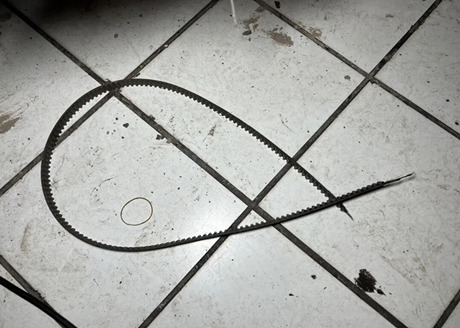
Judging by how the belt failed, the break line was not clean and even.
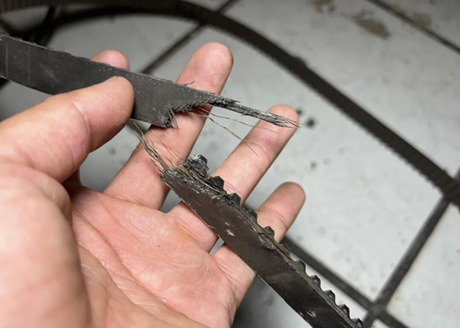
Take a closer look at the inner surface of the belt, it is constructed with special cords embedded in rubber.
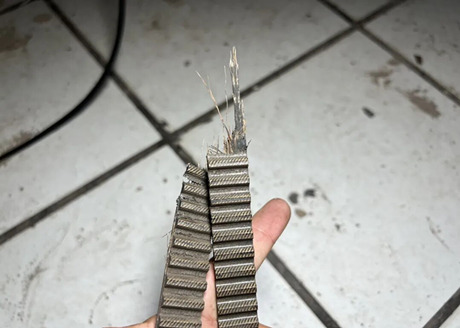
When bending the inner side of the timing belt by hand, obvious aging cracks can be seen on these belt teeth.
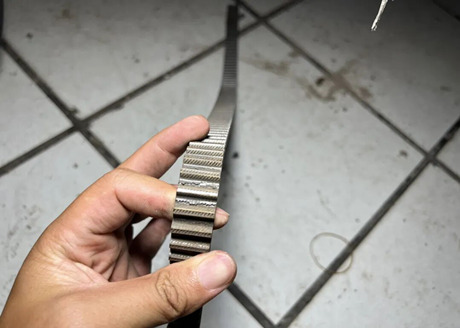
After seeing the snapped timing belt, the vehicle owner asked the mechanic why the belt broke all of a sudden.
The mechanic explained: “Your Lynk & Co is fitted with a three-cylinder engine. The manufacturer recommends timing belt replacement at 100,000 kilometers or 6 years, whichever comes first. Your vehicle has hit 150,000 km now, far exceeding the recommended service interval. Moreover, a timing belt does not necessarily break under acceleration, deceleration or idle conditions — failure can happen at any time without warning.”
The owner then asked if simply replacing the timing belt would fix the issue.
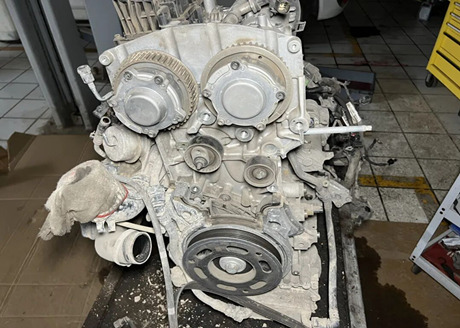
“That won’t work,” the mechanic replied. “Once the timing belt snaps, the pistons are likely to collide with the valves and bend them. Bent valves cannot seal properly, resulting in low cylinder compression. The engine will be unable to run, so we have to remove the cylinder head for repairs.”
After hearing this, the owner felt regretful. The mechanic had advised replacing the timing belt last year, but the owner decided to put it off. He never expected the belt to snap abruptly.

READY FOR A SUBSCRIPTION?
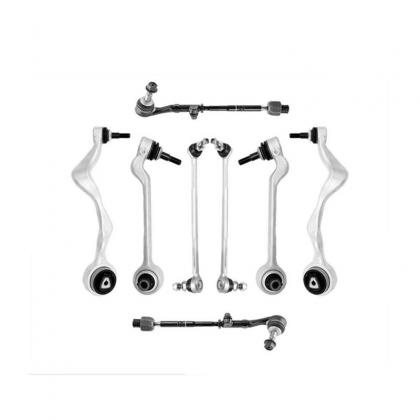
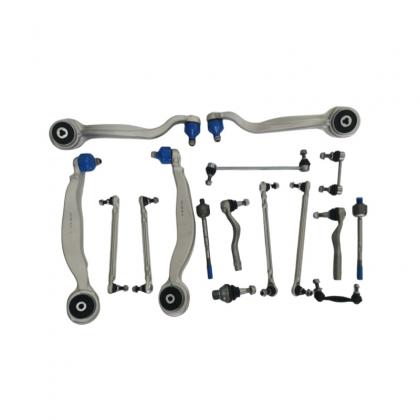
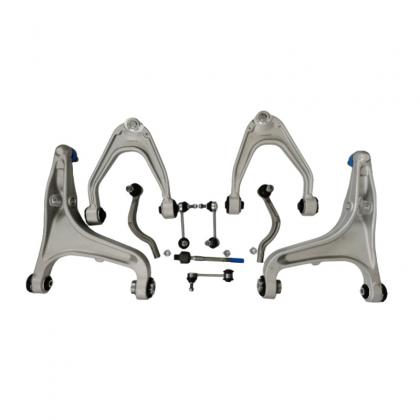
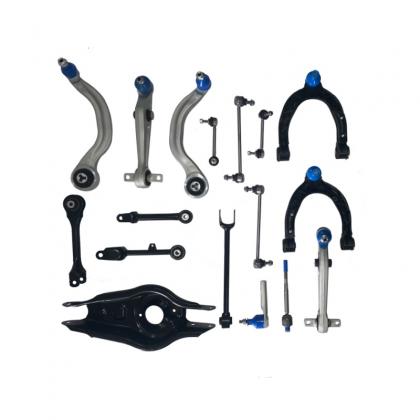
SMK company supply auto parts for below car aftermarket parts: Japanese car: Toyota, Honda, Nissan, Mazda, Subaru, Mitsubishi, Suzuki, Isuzu... European car: BMW, Benz, VW, Audi, Skoda, Porsche, Maserati, Renault, Peugeot, Citroen, Fiat, Opel, Land Rover... American car: Tesla, Ford, Chrysler, Cadillac, Buick, GMC, Chevrolet, Lincoln, Fiat, Dodge, ... Korean car: Hyundai, Kia, Daewoo... Chinese car: Chery, Geely, GreatWall, Haval, BYD, Changan, JAC... We supply parts worldwide: USA, Canada, Europe, Mexico, Colombia, Korea... We are leading supplier for below auto parts: Suspension & Steering Parts(Control Arm, Steering Tie Rod, Stabilizer Link...) Tesla Aftermarket Parts. Engine Mounting/Transmission Mount SMK Auto parts is specifically designed for the automotive repair parts. Our chassis components undergo rigorous testing to easily withstand the complex and variable road conditions and climate. The products not only offer exceptional durability but also provide broad compatibility and excellent stability, ensuring long-term, reliable support for your vehicles. Many overseas clients have established long-term partnerships with us. With the continuous accumulation of customer resources, many overseas clients entrust us with the production of various types of automotive parts products. In order to meet the diversified needs of customers, we have actively expanded new product lines. We adhere to high manufacturing standards, ensuring each product meets the strict safety and durability requirements of different markets. We invite customers from worldwide to choose our products and provide stronger protection and performance upgrades for your vehicles! SMK always adhere to customer-centric, continuously improve product quality and service levels, and strive to create greater value for global customers. In the future, we will continue to adhere to the principle of “quality first, customer first” and work hand in hand with our partners to create a better future.
 IPv6 network supported