 Language
 English
 français
 Deutsch
 русский
 español
 português


What Are You Looking For?

Applicable scenarios: luxury cars, high-end family cars, pursuing stability and driving quality.
Applicable scenarios: household commuting, commercial vehicles, and pursuing low-cost car maintenance.
3. American parts (Buick/Chevrolet/Ford, etc.)
Process accuracy: The chassis parts are thick and stable, but the precision is average, and there are more minor noises.
Material: The chassis has many cast iron parts, which are thick and sturdy; Rubber and plastic parts have weak aging resistance.
Design features: The body structure is rough, and some car models have unreasonable circuit and pipeline designs.
Durable common problems: The chassis components are resistant to manufacturing, but there are many electronic minor problems, oil seal leakage is common, and the gearbox is prone to minor malfunctions.
Adaptation price: Original accessories are relatively expensive, with average circulation rate, and some obscure parts are difficult to find.
Applicable scenarios: Pay attention to the thickness and comfort of the chassis, and be able to accept minor issues.
4. Domestic parts (Changan/Geely/Haval/BYD, etc.)
Process accuracy: In recent years, there has been a significant improvement, with mainstream brand accuracy approaching that of joint ventures, while low-end accessories vary greatly.
Material selection: High end models use high-quality materials, while affordable models are lightweight to reduce costs.
Design features: Strong compatibility and adaptability, many chassis components benchmark against joint venture universal structures, and high interchangeability.
Durable common problems: the new model has stable quality, while the old model has small abnormal noises and the rubber parts age too quickly; The durability of the entire vehicle has greatly improved now.
Adaptation price: The highest cost-effectiveness, cheap accessories, sufficient supply, and a wide selection of OEM/branded parts.
Applicable scenarios: Domestic car maintenance, replacement of joint venture chassis parts, preferred for controlling maintenance costs.
5、 Summary
German series: high precision, complex structure, good texture, easy to leak oil and damage sensors in the later stage, expensive accessories.
Japanese: Simple structure, extremely durable, low failure rate, and lowest maintenance cost for cars.
American series: The chassis is thick and the materials used are solid, but there are more minor noises and electronic problems.
Domestic: the king of cost-effectiveness, in recent years, quality has been benchmarked by joint ventures, parts are cheap and easy to find, and maintenance costs are the lowest.

READY FOR A SUBSCRIPTION?
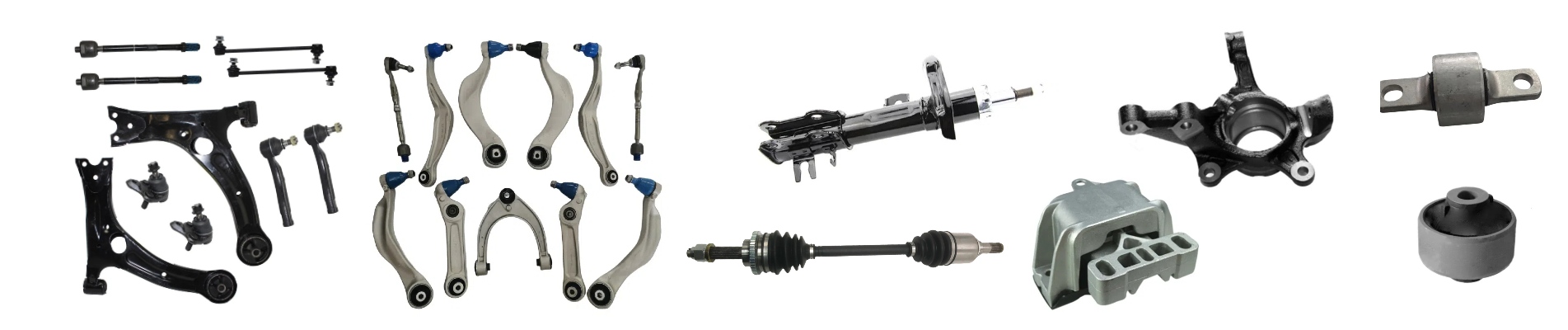
SMK company supply auto parts for below car aftermarket parts: Japanese car: Toyota, Honda, Nissan, Mazda, Subaru, Mitsubishi, Suzuki, Isuzu... European car: BMW, Benz, VW, Audi, Skoda, Porsche, Maserati, Renault, Peugeot, Citroen, Fiat, Opel, Land Rover... American car: Tesla, Ford, Chrysler, Cadillac, Buick, GMC, Chevrolet, Lincoln, Fiat, Dodge, ... Korean car: Hyundai, Kia, Daewoo... Chinese car: Chery, Geely, GreatWall, Haval, BYD, Changan, JAC... We supply parts worldwide: USA, Canada, Europe, Mexico, Colombia, Korea... We are leading supplier for below auto parts: Suspension & Steering Parts(Control Arm, Steering Tie Rod, Stabilizer Link...) Tesla Aftermarket Parts. Engine Mounting/Transmission Mount SMK Auto parts is specifically designed for the automotive repair parts. Our chassis components undergo rigorous testing to easily withstand the complex and variable road conditions and climate. The products not only offer exceptional durability but also provide broad compatibility and excellent stability, ensuring long-term, reliable support for your vehicles. Many overseas clients have established long-term partnerships with us. With the continuous accumulation of customer resources, many overseas clients entrust us with the production of various types of automotive parts products. In order to meet the diversified needs of customers, we have actively expanded new product lines. We adhere to high manufacturing standards, ensuring each product meets the strict safety and durability requirements of different markets. We invite customers from worldwide to choose our products and provide stronger protection and performance upgrades for your vehicles! SMK always adhere to customer-centric, continuously improve product quality and service levels, and strive to create greater value for global customers. In the future, we will continue to adhere to the principle of “quality first, customer first” and work hand in hand with our partners to create a better future.
 IPv6 network supported